Most outbreaks follow the same five stages of genital herpes, from the first infection to the virus going quiet, waking up, blistering and finally healing. Knowing which stage you're in helps you understand how contagious you are, when treatment works best and what's likely to happen next.
Below, we walk through each of the genital herpes stages in plain English. We'll also cover how long a herpes outbreak lasts, how a first outbreak differs from a repeat one, and when it's worth getting checked.
Most outbreaks follow a similar pattern each time, so once you know the signs, you can usually spot one coming and act early.
What is genital herpes?
Genital herpes is a common sexually transmitted infection (STI) caused by the herpes simplex virus (HSV).1 There are two types: HSV-1 and HSV-2.
HSV-1 is best known for causing cold sores around the mouth. HSV-2 has traditionally been linked with genital herpes. But both types can infect the genitals.
In fact, HSV-1 now causes most first episodes of genital herpes in the UK, while HSV-2 is the type more likely to cause repeat outbreaks.2 HSV-1 usually reaches the genitals through oral sex.3
Genital herpes isn't only an HSV-2 problem. A partner's cold sore can cause it too.
How many people have genital herpes?
Herpes is one of the most common infections in the world. Around 520 million people aged 15 to 49 (13%) have HSV-2.3
An estimated 205 million people in that age group had at least one episode of genital herpes symptoms in 2020.3 Plenty more never notice a thing. Most herpes infections cause no symptoms or only mild ones, so many people don't know they have it.3
How do you get genital herpes?
Genital herpes spreads through skin-to-skin contact with the infected area, including during vaginal, anal and oral sex. You can also get it in the following ways:1
- If a cold sore touches your genitals
- From fingers that have touched someone else's infected skin
- By sharing sex toys with someone who has herpes
- From someone with no visible blisters or sores at all
You can't catch genital herpes from towels, toilet seats, swimming pools or saunas, because there's no skin-to-skin contact.1
Herpes can be passed on through asymptomatic shedding, where the virus is active on the skin even though nothing's visible. It's an important cause of transmission to know about.2 So it's worth taking a few sensible steps:
- Use condoms, knowing they lower the risk but cannot remove it completely
- Be open with your sexual partners about your status
- Go to a sexual health clinic as soon as possible if you think you've been infected
You can also spread the virus to other parts of your own body, like your fingers or thighs, by touching a sore. This is mostly a concern during a first outbreak, so wash your hands after touching the area.2
Condoms help, but herpes can still pass on from skin they don't cover. Avoiding sex when you have symptoms is safer.
What are the stages of genital herpes?
If you get symptoms, genital herpes tends to cycle through five stages: the primary infection, the latent stage, the prodrome, the blister stage and the healing stage. After your first outbreak, the cycle restarts from the latent stage each time the virus wakes up.
Not everyone goes through every stage. Lots of people with herpes never get symptoms at all.3 Prefer to watch? Our video guide to the stages of genital herpes covers the same ground.
Primary infection stage
This is your first outbreak. If symptoms show up straight away, they usually appear 2 days to 2 weeks after you catch the virus. But only around a third of people with HSV-2 get symptoms when they're first infected.2
That means a "first" outbreak isn't always a new infection. Blisters can take months or even years to appear, so it may be an older infection showing itself for the first time.1
A primary outbreak is usually the most severe. In one large study, around two in three people with a primary outbreak had flu-like symptoms.4 You might notice:
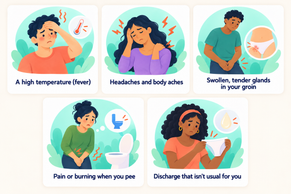
- A high temperature (fever)
- Headaches and body aches
- Swollen, tender glands in your groin
- Pain or burning when you pee
- Discharge that isn't usual for you
Next, the skin around your genitals, anus, thighs or bottom may turn red and itchy. Small blisters then appear, which burst to leave painful open sores.1
If you already have HSV-1 (from cold sores, for example) and then catch HSV-2, the first outbreak is usually milder.2
Latent stage
Once the sores heal, the virus doesn't leave. It travels along your nerves and settles in a cluster of nerve cells near the base of your spine, where it lies dormant.2
You won't have symptoms during this stage. But the virus can still wake up briefly and shed from your skin without you noticing. This is most common in the first year after infection and in people who get frequent outbreaks.2
Prodrome stage
The prodrome is the early warning stage. Something triggers the dormant virus, and it travels back along the nerve to your skin.
Many people feel an outbreak before they see it, as tingling, itching or burning where the sores will appear.3 These signs usually come on shortly before any blisters.
The NHS lists a range of common triggers.1 Some you can avoid:
- UV light on the area, such as sunbathing or sunbeds
- Friction from sex or tight clothing
- Smoking
- Drinking alcohol
Others are harder to control:
- Being unwell
- Stress
- Your menstrual cycle
- Surgery on your genital area
- A weakened immune system, for example from chemotherapy or HIV
Knowing when you're likely in this stage is important because you're contagious from the very first tingle, before any blisters appear.1 It's also the best time to start antiviral tablets, which can stop some outbreaks from blistering at all when taken at the first signs.5
Get to know how your own early warning signs feel. Spotting them quickly gives treatment its best chance of working.
Blister stage
Once the virus reaches the surface, blisters form. This is when herpes is easiest to spot, and when it's most contagious.3 The blisters go through their own mini-stages:
- Red bumps - small, itchy red bumps appear on or around the genitals, bottom, groin or thighs
- Blisters - the bumps fill with fluid
- Open sores - the blisters burst and ooze, leaving painful sores (ulcers)
- Crusting - the sores dry out and scab over
Early bumps can look a lot like spots or ingrown hairs. On brown or black skin, the sores may look less red.1 Repeat outbreaks don't always look the same either. They can show up as small cracks or patches of red, sore skin.2
Open sores can occasionally pick up a second infection, such as thrush, usually in the second week.2 Keeping the area clean helps.
Healing stage
The scabs eventually fall off, leaving pink or sensitive skin underneath. Loose clothing helps here, as tight waistbands and seams can irritate it.
You're still contagious until the sores have fully healed.1 After that, the virus heads back into the latent stage until the next trigger.
Do not have vaginal, anal or oral sex from the first tingle until every sore has completely healed.
How long does a herpes outbreak last?
It depends on whether it's your first outbreak or a repeat one.
First outbreak
A first outbreak lasts the longest. In a classic study of people with genital herpes, sores from a primary outbreak lasted around 19 days on average, so roughly 2 to 3 weeks.4
Antiviral tablets started within 5 days of symptoms appearing can stop a first outbreak getting worse.1
Recurrent outbreaks
Repeat outbreaks are usually milder and shorter.1 In the same study, recurrent sores lasted around 10 days on average.4 They also tend to appear on one side, in the same spot each time.2
Antivirals taken at the first sign of a recurrence shorten it by a median of 1 to 2 days.2 Many repeat outbreaks settle on their own, so you may not need treatment every time.1
The first outbreak is the toughest. Most people find later ones are quicker and easier to manage.
Are the stages of genital herpes different for men and women?
The stages are the same for everyone. Where symptoms show up, and how strong they are, can differ.
In men, blisters often appear in a group on the penis, or around the anus, thighs and bottom.1 Herpes in the urethra (the tube you pee through) can cause burning when you pee or a discharge.2
In women, sores can appear on the vulva, around the vaginal opening, and on the anus, thighs and bottom.1 They can also form on the cervix, where you can't see them.2
Women tend to have more severe symptoms during a first outbreak.4 Men tend to get repeat outbreaks a little more often, around 20% more than women in one study.6 Their recurrent outbreaks can also last slightly longer.7
Which stage of genital herpes is most contagious?
You can pass herpes on at any stage, but the risk isn't equal.
It's highest when blisters and sores are present.3 Genital herpes is very easy to pass on from the first tingle of a new outbreak until the sores have fully healed.1 So the primary infection, prodrome, blister and healing stages all carry a higher risk.
The latent stage carries the lowest risk, but not zero. Asymptomatic shedding means herpes can still spread when your skin looks completely normal.3 The NHS says the risk of passing it on without symptoms is higher in the first 6 months after infection and is rare after 2 years.1
Daily antiviral tablets help here too. Clinical trials show they greatly reduce asymptomatic shedding.2
Feeling fine does not always mean you are not contagious. Condoms and honest conversations still matter between outbreaks.
How often do genital herpes outbreaks happen?
Everyone's different. After a first outbreak of HSV-2, people have around four repeat outbreaks a year on average.6
Genital HSV-1 comes back far less often. In one study, people averaged just over one recurrence in their first year.8
The encouraging part? Over time, outbreaks tend to happen less often and become less severe. Some people never have another one.1
That's why it's useful to know which type you have. A swab test from a sexual health clinic can tell you.2
Knowing your herpes type is more than a detail. It's one of the best clues to how often outbreaks are likely to return.
Can you prevent genital herpes outbreaks?
You can't always stop an outbreak, but you can lower the odds. Start with the triggers you can control, like sunbeds, smoking, drinking and friction from tight clothing. Lubricant can help reduce friction during sex.1
Frequent outbreaks? Daily antiviral tablets, known as suppressive therapy, are an option. People who have more than 6 outbreaks a year may benefit from taking them for 6 to 12 months.1 In trials, people on suppressive therapy had fewer outbreaks or none at all.2
Suppressive therapy is usually stopped after a year at most, to check how often outbreaks come back without it.2
How is genital herpes treated?
Many outbreaks clear up on their own. But antiviral tablets can ease symptoms, shorten outbreaks and, taken daily, reduce how often they happen. Our guide to treating herpes goes into more detail.
Timing matters. For a first outbreak, antivirals should be started within 5 days of symptoms appearing.1 For repeat outbreaks, treatment started before any bumps form gives the biggest benefit.2
If your prescriber agrees, keeping a course of tablets at home means you can start the moment you feel that first tingle.
The three main options are below.
Aciclovir
Aciclovir is an antiviral tablet that stops the herpes virus from multiplying. It reduces how severe an outbreak is and how long it lasts.2
Valaciclovir
Valaciclovir is a prodrug of aciclovir. That means your body converts it into aciclovir once you've swallowed it.5 It's absorbed more efficiently, so you take it less often, usually twice a day to treat an outbreak or once a day for suppression.5
Valtrex
Valtrex is the original branded version of valaciclovir. It contains the same active ingredient and works in the same way.5
Studies comparing these tablets head to head haven't found one to be more effective than another. Antiviral creams are less effective than tablets, and adding a cream to tablets gives no extra benefit.2
How can you soothe genital herpes symptoms at home?
Medication isn't the only thing that helps. The NHS suggests a few simple steps to make an outbreak more bearable.1
- Keep the area clean with plain or salt water to stop the sores getting infected
- Hold an ice pack wrapped in a flannel against the area to ease pain
- Apply petroleum jelly (such as Vaseline) or a painkilling cream like 5% lidocaine to make peeing less painful
- Wash your hands before and after applying any cream or jelly
- Pee while pouring water over your genitals
- Wear loose clothing that won't rub
- Take over-the-counter pain relief such as paracetamol or ibuprofen
Never put ice directly on your skin, and do not touch the sores unless you are applying cream.
Is genital herpes curable?
There's currently no cure for genital herpes. Once you have the virus, it stays in your body.1
Sounds scary, but most people have no symptoms or only mild ones.3 When outbreaks do happen, they're temporary, tend to ease over time and can be managed with treatment.
It's completely normal to feel worried after a diagnosis. Most people adjust with time, and charities like the Herpes Viruses Association offer support.2
When should you see a doctor about genital herpes?
If you think you have genital herpes for the first time, go to a sexual health clinic as soon as possible. A swab test can only be done while you have visible blisters or sores, so try not to wait for them to heal.1
Get medical advice if:
- You have symptoms of genital herpes for the first time
- You're pregnant and think you might have genital herpes
- You have HIV or a weakened immune system
- You're having more than 6 outbreaks a year
- New sores are still appearing after 5 days of antiviral treatment
Get urgent medical help if:
- You cannot pee
- You have a severe headache with a stiff neck or sensitivity to light
These can be signs of rare complications that may need hospital treatment.2
If you're pregnant, the risk to your baby is low if you had genital herpes before pregnancy. It's higher if you catch it for the first time late in pregnancy, so see your midwife or GP if you think you have it.1
Pregnant? Make sure your midwife knows about any history of herpes, even if your last outbreak was years ago.
Frequently asked questions
What do the early stages of genital herpes look like?
Early genital herpes often starts with tingling, itching or burning before anything is visible. Small red bumps then appear, which fill with fluid and burst into painful sores. These early bumps are easily mistaken for spots or ingrown hairs. During a first outbreak, some people also feel flu-like and notice swollen glands in their groin.
How soon do genital herpes symptoms appear after exposure?
If symptoms appear straight away, it’s usually 2 days to 2 weeks after catching the virus. But most people don’t get symptoms when they’re first infected. Blisters can take months or even years to show up, so a first outbreak doesn’t always mean you caught herpes recently, or from your current partner.
Can you spread genital herpes without an outbreak?
Yes. Herpes can be passed on through asymptomatic shedding, when the virus is active on the skin without any visible signs. It’s most common in the first year after infection. Condoms lower the risk and daily antiviral tablets reduce shedding. The risk is still highest during an outbreak, so avoid sex from the first tingle until sores heal.
Will genital herpes go away without treatment?
Symptoms usually clear up on their own, especially during repeat outbreaks, which tend to be milder. The virus itself stays in your body, though, so outbreaks can come back. Antiviral tablets don’t remove the virus, but they can ease symptoms, shorten outbreaks and, taken daily, reduce how often outbreaks happen.
Is there an over-the-counter treatment for genital herpes?
Antiviral tablets for genital herpes, such as aciclovir and valaciclovir, are prescription-only medicines in the UK. Over-the-counter painkillers like paracetamol or ibuprofen, petroleum jelly and salt-water bathing can all ease discomfort. Antiviral creams are less effective than tablets, so speak to a pharmacist or prescriber about the right option for you.
Can you catch genital herpes from a toilet seat or swimming pool?
No. Genital herpes spreads through skin-to-skin contact with the infected area, usually during vaginal, anal or oral sex. You can’t catch it from toilet seats, towels, swimming pools or saunas. It can pass on through shared sex toys, though, so wash them and put a fresh condom on them between partners.
References
- NHS. Genital herpes. NHS website; 2023. nhs.uk
- Patel R, Green J, Clarke E, et al. 2014 UK national guideline for the management of anogenital herpes. International Journal of STD & AIDS. 2015;26(11):763-776. doi:10.1177/0956462415580512
- World Health Organization. Herpes simplex virus. World Health Organization; 2025. who.int
- Corey L, Adams HG, Brown ZA, et al. Genital herpes simplex virus infections: clinical manifestations, course, and complications. Annals of Internal Medicine. 1983;98(6):958-972. doi:10.7326/0003-4819-98-6-958
- GlaxoSmithKline UK. Valtrex 500 mg film-coated tablets: Summary of Product Characteristics. Electronic Medicines Compendium; 2026. medicines.org.uk/emc
- Benedetti J, Corey L, Ashley R. Recurrence rates in genital herpes after symptomatic first-episode infection. Annals of Internal Medicine. 1994;121(11):847-854. doi:10.7326/0003-4819-121-11-199412010-00004
- Mindel A, Coker DM, Faherty A, et al. Recurrent genital herpes: clinical and virological features in men and women. Genitourinary Medicine. 1988;64(2):103-106. doi:10.1136/sti.64.2.103
- Engelberg R, Carrell D, Krantz E, et al. Natural history of genital herpes simplex virus type 1 infection. Sexually Transmitted Diseases. 2003;30(2):174-177. doi:10.1097/00007435-200302000-00015
This article is intended for informational purposes only and does not replace professional medical advice. Always read the patient information leaflet supplied with your medication and speak to a healthcare professional if you have specific concerns.